During this period of the war Britain, together with her Empire and America, began to take the fight to the Germans and the Japanese. The Italians were quickly knocked out of the war after the North African campaign ended and Sicily and Italy were invaded. Germany began to suffer serious setbacks in its campaign in Russia, as were the Japanese in the Pacific. The Battle of the Atlantic began to turn a corner, with the U-boat threat increasingly defeated. The bombing campaign against Germany started to ratchet up, with the RAF bombing by night and the American 8th Air Force by day. The overwhelming preoccupation of the Allies during this time was the preparation for the landing on German-controlled Europe, the operation called “The Second Front”.
On the home front, food still occupied a central focus in people’s thoughts throughout the county. On the production side, farming had never been so important, and yields remained high as farmers pulled out all the stops to cultivate as much land as possible. Increasingly the farm labour workforce depended on the Women’s Land Army, who were joined by more and more Italian POWs who were present in Norfolk in some numbers, working on farms or as labourers. Rationing on some staple foods continued, although extra sugar was allowed to assist in jam-making. Dried eggs became very common, as they were imported from America and Canada, and were issued at a rate of one tin per person every two months. Opinions were extremely divided on this as a substitute for the fresh equivalent.
Recipes began to appear on the radio and in newspapers, promoted by the Government, for meatless, fishless and eggless meals. In particular, “Woolton’s meatless pie”, named after a government minister, was strongly recommended. In rural areas such as Brancaster rabbits were an essential source of meat, and rabbit stew became a favourite. Another measure to affect Brancaster was the initial proposal by the Government to centralise all fish sales, which meant transporting catches from the Staithe. This quickly broke down, however, as it was found to be utterly impractical because of the high waste and unworkable arrangements.
Clothing rationing was tightened further, and the slogan “Make do and mend” began to appear in popular radio programmes and Government broadcasts. Hand-me-downs for children were also very common in families to save money and ration coupons. The county saw a number of salvage campaigns in order to recycle everything, with metal objects being an important emphasis. The Government encouraged war savings, and local communities to sponsor warships and planes; Norfolk rose to these challenges by raising large sums.
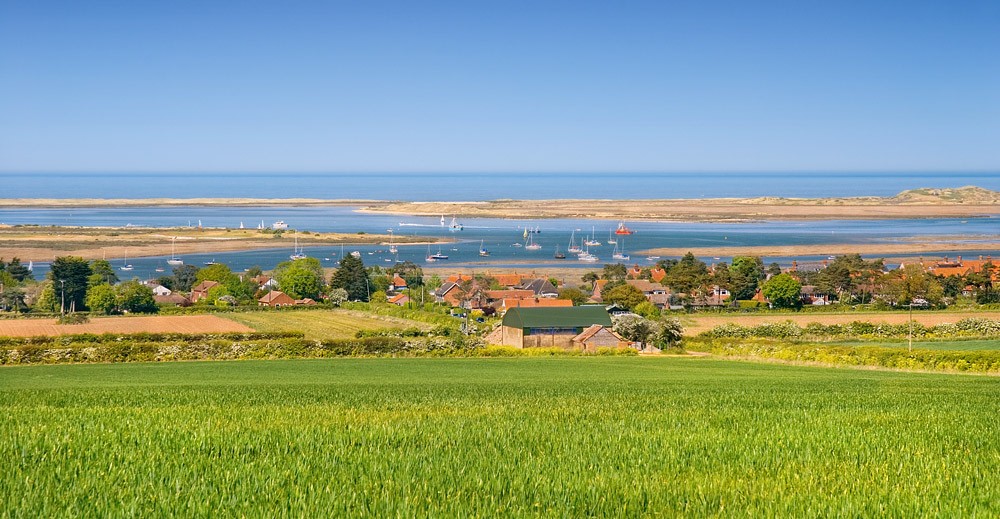
Across the county exercises were held for soldiers in training, preparing for the D-Day invasion. Brancaster was a hive of activity; soldiers and their vehicles became a regular sight. Titchwell Marsh was used extensively as a gunnery range for tanks, and Brancaster beach for rehearsals for landing craft, as it was very similar to the Normandy coast. Air activity intensified, not only with bombing and Coastal Command aircraft, but also with planes using the Titchwell and Thornham beaches as bombing ranges.
Norfolk families of POWs held by the Japanese began at last to get news of husbands and sons, although this could be a very mixed blessing, given the brutality of this imprisonment. There were, of course, POWs also held in Germany, but these received better conditions. Families were also, quite naturally, worried about loved ones who were about to land on European soil – knowing as they did the strength of the defences they would face – as well as about those fighting the Germans in Italy and the Japanese in Burma.
Americans were increasingly active across the County as the 8th Air Force gained in strength. American soldiers were carrying out exercises in Norfolk, and land had been requisitioned by the Government for this purpose – 18,000 acres in Thetford, where a Nazi village was erected for realism. Many troops were billeted in this time in civilian homes.
Those living in Brancaster would have been aware of the daily passage of aircraft, either on their way to bomb Germany, or to carry out Coastal Command duties. Some restrictions on movement were lifted, although large areas of the Norfolk coast became a protected zone, with strict conditions of entry; identity cards were essential at all times. The V1 and V2 bombardment began, and some regions in the county were hit; however, more people were evacuated from city areas where these weapons had been directed. The Home Guard was stood down, and there was some demobilisation for older men.
From 1944 to 1945 life in Brancaster had been hectic with all the military activity on the ground and in the air. People in the village had put up with years of rationing, privation and shortages, as well as fear and worry. A final end to the war was in sight, although this would mean that, during D-Day and the follow-up battles, thousands of young men would be in danger before the Germans were forced to surrender. Abroad, the campaigns in Italy and Burma were continuing and, again absorbing men and materials and adding to the concern of families back home.
It is certain that many people living in Brancaster realised that, after the war was over, life was not going to return to how it had been in 1939. The status quo was not an option for the majority in terms of health, housing, education and work. It was recognised that there had to be a fairer distribution of the country’s assets and wealth. For many families, even if there was a happy ending, the war years were a time of worry; the end of the war was for many a new beginning. Despite the hardship of continuing rationing and hard winters, it was a time for marriages and births. Brancaster does not appear to have held a big celebration at the end of the war, settling instead for a series of homecoming parties.
1945 marked a radical change in how the country was governed, with the election of the Labour Party with manifesto commitments on health, education, housing and welfare, as well as the nationalisation of the key public services such as water, electricity and the railways. The benefits of these measures only trickled through to Brancaster over time, but the village had commenced in its slow and measured way to its own changes, many of which can be seen here today.