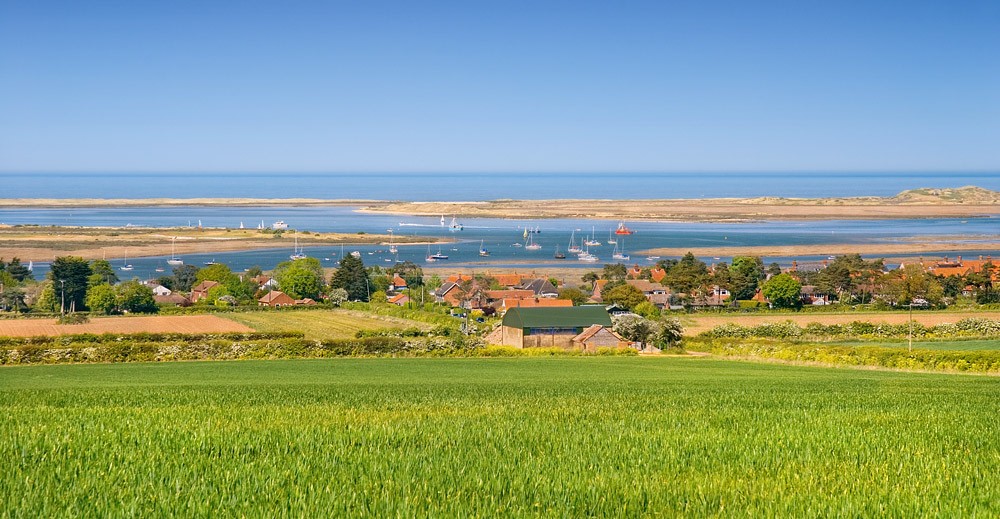
Life changed significantly as 1940 progressed, even in the rural communities such as Brancaster in Norfolk. The German army began its major assault in Belgium, Holland and France, quickly overcoming them. This resulted in the steady retreat of the British army and its eventual evacuation from Dunkirk. The successful evacuation of most of the British army meant that Britain, supported by the Empire, was on her own facing a continent dominated by the Nazis under their leader, Adolf Hitler.
Norfolk, because of its location, had a strong RAF presence; there were 15 airfields and 4 under construction. The defence of the British army during the Dunkirk evacuation and the bombing attacks on German coastal areas and warships were carried out with the involvement of Norfolk airfields. The airfield at Bircham Newton, and then at Docking, were used mostly by Coastal Command to carry out surveillance of the North Sea and the English Channel; the villagers of Brancaster would have been used to the noise of aircraft passing overhead on a daily basis.
The main change for the village, with Europe being under occupation, was the threat of imminent invasion. The period known as “The Phoney War” was over, and war became a serious issue for the local people, particularly those living in a village such as Brancaster – situated on a very vulnerable beach, ready-made for an invading army. The villagers became used to the movement of large bodies of soldiers, some of whom were stationed on the beach and in Dormy House Hotel.
The blackout continued to be rigorously enforced and food rationing, introduced in January 1940, began to have a serious effect. In rural villages such as Brancaster, people were generally better off in terms of food, as they had access to offal, together with plentiful rabbits and blackbirds. Many women were already skilled in eking out the food available; strangely, blackbird pie was much sought after. However, as some diaries record, there was difficulty in getting hold of matches, paraffin and other things people deemed essential.
Some families in Norfolk were of course closely affected by the war, following casualties in France or at sea. A number of soldiers had been taken prisoner (POWs), and information about them was hard to come by for families. Many ships around the coast had also be requisitioned by the Navy to assist in the Dunkirk evacuation, and their crew temporarily enlisted into the Navy to crew them. Some of these were lost or were casualties, affecting local communities.
Troops were situated along the Norfolk coast and a small battery of two guns installed on Brancaster beach. These were named Clara and Maud after the licensees of the Ship Inn, which had become a popular watering-hole for off-duty soldiers. Defences began to appear in coastal areas, such as pillboxes, barbed wire, beach obstacles and obstacles to prevent parachutists. A walk along the sea wall at Brancaster will show that some of these still exist. Some residents were evacuated from particularly sensitive areas, and others left of their own accord. Many aliens were rounded up and spent the war in camps such as those on the Isle of Man and, in extreme cases, were imprisoned. The round-up included members of fascist organisations and extreme trade unionists. It became an offence to photograph beach defences; signposts across the county were removed, as were all maps. The Home Guard took over many of the duties performed by the regular army and spy mania affected whole communities.
The Battle of Britain took place between July and September 1940. During this period the risk of invasion was at its height, with invasion barges and ships being collected in French ports and troops congregating on the coast. Some bombing took place in the county, particularly on Norwich, Yarmouth and Cromer; strangely, all sirens, whistles and horns were banned, as was the flying of kites. Pleasure craft were all removed to inland waters, and metal railings removed from churches and public buildings to be recycled for war purposes.
Farming of course remained a major activity for Norfolk; farmers were strongly encouraged to increase production and bring all land into cultivation. Some aspects of farming did suffer however, particularly pigs and chickens, as the feedstuffs had to be imported. Restrictions were placed on hotels and restaurants in respect of the size of meals; meat and fish courses in the same meal were forbidden. Recipes for meatless and fishless pies and stews were provided on the radio and in newspapers; jam-making became very common across the county, as some fruits were still available to buy or pick in the countryside.
During this period people in Britain became very aware that the country was on its own, facing a hostile continent. The actual threat of invasion began to fade, particularly when Hitler decided to attack Russia, but the hope of taking the fight to Germany was unrealistic. National effort was devoted to keeping sea lanes safe from submarines and aircraft in order to maintain the flow of food and raw materials, which meant the country could sustain its resistance. Churchill spent much time during this period trying to get American support, particularly in terms of armaments and materials. The American public were resistant to becoming actively involved.
Across the world the British Empire was under threat, in the Middle East from Germany and Italy, and in the Far East with the growing threat posed by Japan. The Battle of the Atlantic began to assume critical proportions, as many merchant vessels were sunk, mainly by submarines, in what was called “The First Happy Time”. Some bombing raids were carried out on Germany, but the RAF was faced with too many inadequate aircraft and navigational aids to have much effect on German production of armaments.