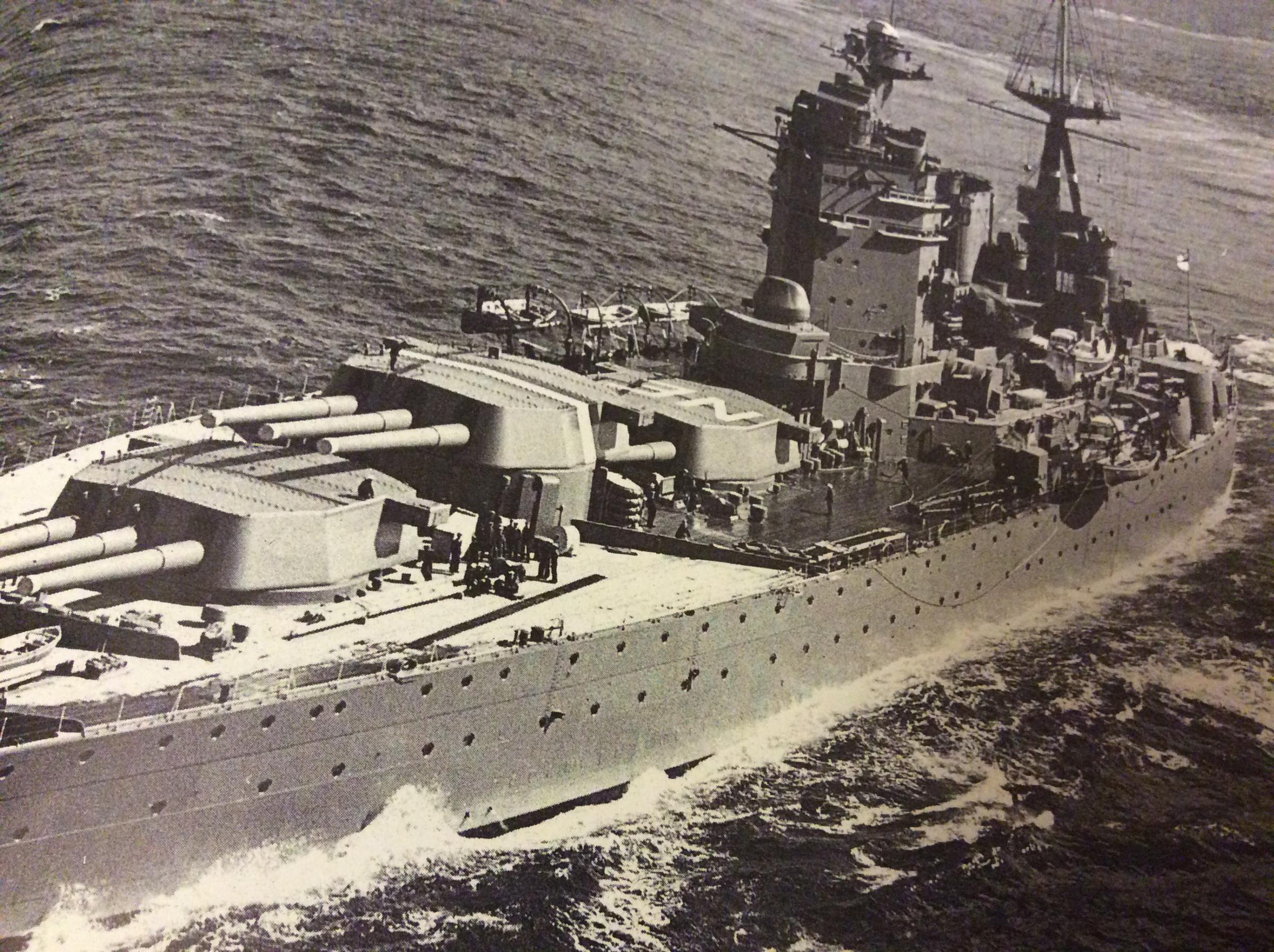
World War One had seen the largest clash of capital ships in modern times. The capital ship was the dreadnought, a massive, heavily armoured and armed warship that dominated navies. After the end of the war Britain scrapped many of its capital ships and, following international treaties, was allowed to build two new dreadnoughts or battleships in the inter-war period to maintain parity with the Americans.
The two new battleships, named HMS Nelson and HMS Rodney, were launched at the end of 1925 and, although they were very powerful, had to be built within a maximum tonnage of 35,000 tons by treaty agreement. This meant they sacrificed speed to remain within the limit and never exceeded 24 knots, which was significantly slower than capital ships which were built by other nations when the treaty constraints were no longer in force.
HMS Nelson was commissioned in August 1927 and became flagship of the Atlantic Fleet from 1927 to 1932. The Atlantic Fleet became the Home Fleet in 1932; HMS Nelson was fleet flagship from 1932 to 1939 and again from 1940 to 1941. The ship was extensively refitted from 1937 to 1938 at Portsmouth.
At the start of World War Two HMS Nelson was taking part in operations in the North Sea and was considerably damaged by a mine in December 1939, having to be repaired and refitted at Portsmouth during most of 1940. Following repair, it was again in the North Sea and also undertaking escort duties for Middle East troop convoys to the Cape.
In 1941 the ship was transferred to Force H, based at Gibraltar, where it escorted Malta-bound convoys, and was seriously damaged by an aerial torpedo.
After a refit at Malta and Rosyth, HMS Nelson carried out other convoy duties and took part in the invasion first of North Africa and then of Sicily and Italy in 1943. The Italian armistice was signed on board the ship at Malta on 29th September 1943.
Following a return to the Home Fleet, the ship was next involved in supporting the D-Day operation in June 1944. The naval supporting warships, including HMS Nelson, were crucial in defeating the counter-attacks of the German forces in the battle for Caen, which on the land including a battalion of the Royal Norfolk Regiment. Unfortunately, the ship hit a mine while off Sword beach on 18th June and had to go to the USA for repair and refit.
Its final war deployment was to the Far East, arriving in Columbo in July 1945, before taking the surrender of Japanese forces in the Singapore area off Penang on 2nd September 1945.
After a short commission as fleet flagship of the Home Fleet, on returning home HMS Nelson was used as a training vessel in 1946, and subsequently reduced to the Reserve until 1948, when it was used as a bombing target before being scrapped in 1949.
All Saints Church at Burnham Norton, the birthplace of Horatio Nelson, displays the ship’s plaque as the sole reminder of the part this ship played in defending our freedom close to 80 years ago. The age of the battleship as the capital ship had passed during the Second World War, to be carried on by aircraft carriers, which had shown themselves far more lethally destructive over far greater ranges. They in turn have been replaced as the principal capital ship by the missile-carrying nuclear submarine – with unimaginable destructive power which, hopefully, will never be used.
The pictures show the plaque of HMS Nelson in Burnham Thorpe church and the ship during World War II.