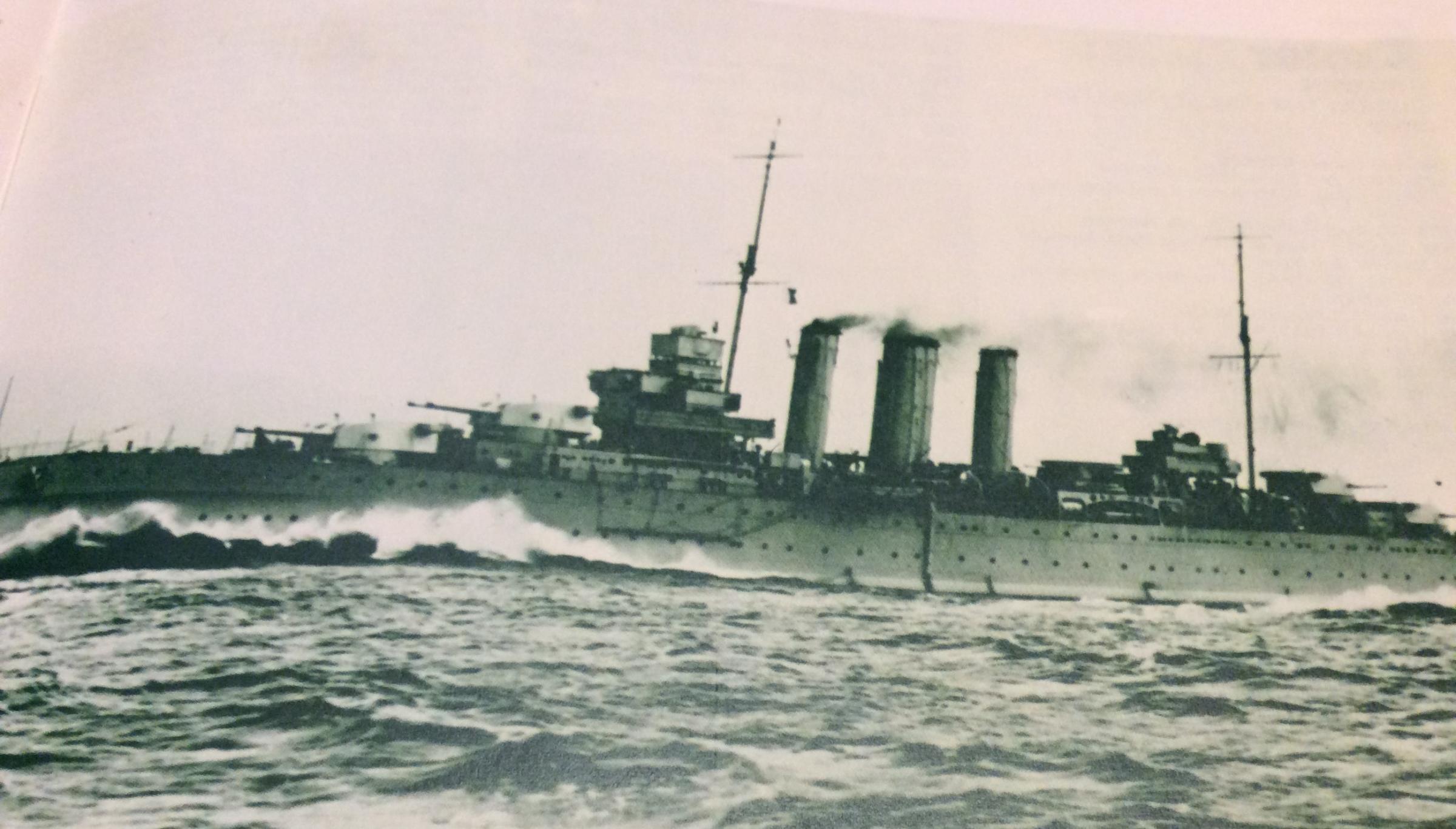
The heavy cruiser HMS Norfolk is included in the articles about D-Day for a number of reasons. The ship was one of the very few Royal Navy vessels to be named after the county; she had a very distinguished career in the Second World War, and HMS Norfolk was scheduled to be one of the bombardment ships on D-Day.
There have been five ships of this name in the Royal Navy over the centuries. The first was built in 1693 as a wooden line of battle ship with 80 guns; this was followed in 1757 by another line of battle ship of 74 guns. The third HMS Norfolk, featured here, was launched in 1928 and commissioned in 1930. The other two Norfolks were more modern vessels – a guided missile destroyer dating from 1967 and a Type 23 frigate from 1987.
A quick glance at the third HMS Norfolk would show a large ship of about 13000 tons loaded. She looked somewhat old-fashioned in comparison with other cruisers as she was slab-sided, had three tall funnels, and a line of portholes along the sides that spoke of very light armour protection. The County Class cruisers of which HMS Norfolk was part were built to protect and control for the far reaches of the Empire. They had impressive speed and endurance and were comparatively roomy for crews. They were also powerfully armed and able to hold their own against all other ships they were likely to encounter, except for capital ships such as battleships and battlecruisers, which were three or four times larger and much more powerfully armed and armoured; however, these were slower, in the main, and could therefore be avoided.
Following commissioning, HMS Norfolk joined the Fleet based as Scapa Flow in the Orkney Islands as flagship of the 8th Cruiser Squadron, before moving to the West Indies. Between 1935 and 1939 HMS Norfolk was in the East Indies, returning home in 1939 for a major refit.
At the outbreak of the Second World War HMS Norfolk was back with the Home Fleet. The ship was damaged by a near-miss torpedo from U47 and sailed to Belfast for repair. On return it suffered bomb damage from an attack on Scapa Flow and went to Clyde for repairs; it was here that radar was fitted, which was to prove very significant over the next year. Following repair of damage, HMS Norfolk saw service in the South Atlantic, hunting surface raiders and escorting convoys carrying troops.
In May 1941 HMS Norfolk was in Icelandic waters and was put on alert with her sister ship, HMS Suffolk, to patrol the Denmark Strait, as the German battleship Bismarck, along with the cruiser Prince Eugen, had gone missing from their Norwegian base. HMS Suffolk, and then HMS Norfolk sighted the two German ships and settled to shadowing them, using HMS Norfolk’s radar. Following the loss of HMS Hood to gunfire from the Bismarck, Bismarck herself was crippled by the planes of the Fleet Air Arm. This allowed the battleships HMS King George V and HMS Rodney to reach the German ship and sink it. HMS Norfolk took part in this final action and scored an early hit on the Bismarck, destroying her conning tower.
Following this action HMS Norfolk was assigned to protect the Arctic convoys that were taking cargoes to Russia and the Northern route. In 1943, while she was escorting a convoy with other warships, the convoy was attacked by one of the last German capital ships still operational, the battlecruiser Scharnhorst. The cruiser screen, including HMS Norfolk, managed to hold the German ship at bay; HMS Norfolk actually scored three hits on Scharnhorst, destroying her radar. HMS Norfolk was present when the British battleship HMS Duke of York arrived to combine with torpedoes from destroyers to sink the German ship – the last engagement between capital ships in the European war. HMS Norfolk was again damaged but had achieved the unique distinction of taking part in three major actions in the Atlantic and Northern waters and achieving hits on the much more powerful Bismarck and Scharnhorst ships.
Following further repair, HMS Norfolk had the honour of taking the Norwegian Royal Family back to Norway at the end of the European war. The ship was then sent out to the East Indies as flagship. In 1948 she returned home, placed in reserve and then scrapped in the following year.
In 1944 HMS Norfolk had been earmarked to provide support to the D-Day landings off Normandy. However, the ship’s action against the Scharnhorst had caused damage, as the vessel was hit by a number of heavy shells. This meant HMS Norfolk spent the invasion time in dock, undergoing repair, and missed this campaign. Nevertheless, the ship had given magnificent service and taken part in the most significant engagements undertaken by the Royal Navy. Amongst the crew there would undoubtedly have been sailors from Norfolk, proud to serve in such a distinguished ship named after their county.
The pictures show HMS Norfolk shortly before World War II and during the war.