The Bocking family has been an integral part of Brancaster society for a very long time, as a walk through St. Mary’s graveyard would attest. During their time in Brancaster the Bockings have made major contributions to village life, fulfilling many roles, including master mariner, policeman, school manager and Parish Councillor. Members of the family worked at Dormy House Hotel, which serviced the Royal North West Norfolk Golf Club; they have also worked at the Ship Inn, the Borthwick apple orchards and the local council, overseeing road maintenance.
Today Gary and Sarah Bocking continue to live in the village and make important contributions in the community. Gary is a successful florist and gardener who is renowned for his floral displays. He has also been a Trustee of the Simms Reeve Institute (the village hall and community centre) and a Parish Councillor. Sarah became the acting Headteacher of Brancaster School in 2010 and subsequently Headteacher in 2011. Although retiring from this role after a decade, Sarah continues to teach at the school.
Some years ago, as part of the Brancaster History Project, I interviewed Gary and his mother, Lorna, about their experiences at Brancaster School and the village generally. This item will deal with Lorna’s recollections in the 1940s: its sequel will focus on Gary at the school in the 1970s and Sarah’s experience as Headteacher.
SOME THOUGHTS ON ATTENDING BRANCASTER CE VA PRIMARY SCHOOL IN THE 1940s
(by Lorna Bocking)
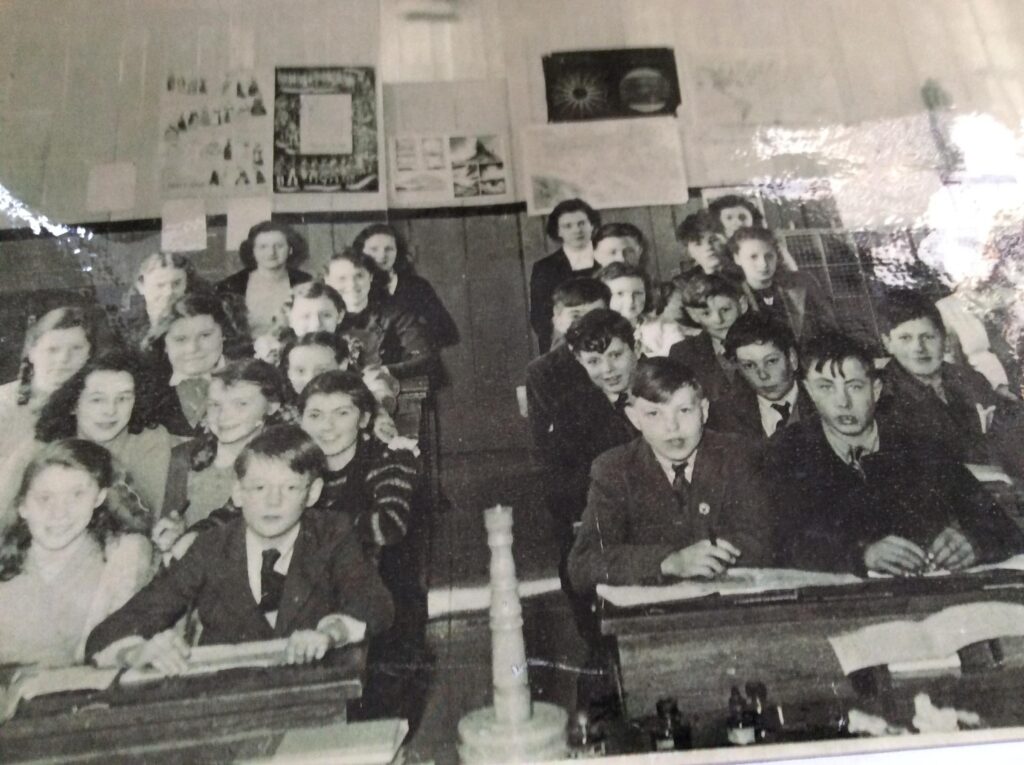
The school was divided into three departments – infant, junior and senior. Pupils left school at 14 from the senior department if they had not passed the scholarship examination at 11 and transferred to the Grammar School in Fakenham. There were about 100 children in the school. The three classes were strictly organised in rows of desks and the teaching was very formal. The Headteacher, who lived in the house next to the school, sat in a central position where he could view the activities of all three classes. Discipline was very strict, and those in trouble were often subject to corporal punishment, particularly the cane.
Pupils came from most of the villages and farms around Brancaster. In the absence of public transport, the children had to walk or cycle to school. The school day was much longer than at present and the school never closed, even in bad weather: pupils had to get there as best they could, notably in the deep snow of 1947.
The curriculum was very formal, with much emphasis on the “3Rs” – Reading, Writing and Arithmetic. Tables were still learned through the whole class reciting together in a kind of chant. Writing was done using ink pens with nibs and each desk had an inkwell; it was the job of the ink monitor to fill each inkwell every day: when a ballpoint pen was brought into school the Headteacher was very cross and forbade the offending pupil to write with it. Pupils were required to do a lot of jobs around the school to ensure it could run efficiently. One of the strangest was that of pumping up water from the well for the Headteacher’s house each day – a really hard task. At 11 years old all the pupils sat the scholarship examination and those who passed went to the Grammar School in Fakenham. They travelled by bus, which visited all the villages, collecting pupils. Very few children from Brancaster passed the scholarship.
Life at the school was not all hard, as the pupils enjoyed a lot of fun as well. Games such as hopscotch, conkers, skipping and tug-o’-war were commonplace; winter brought ice slides and snowball fights. There were also regular outings to the Common and the shoreline to study nature. Meals were very good, as they were cooked on site, using local produce, in what is now the school cloakroom. Lunches had to be eaten at the pupils’ desks, and those who could had to make a contribution to the cost. Children received extra food if they helped in bringing coal to the stoves in the classrooms, which were the only means of heating. There was also a daily ration of 1/3 pint of milk, which was not usually liked, as it was placed next to these stoves, and was very warm when drunk.
The Church of St. Mary the Virgin played an important part in the life of the school. The whole school would attend on major festival days, marching down to the church in “crocodiles”; Ascension Day was a particularly important occasion. An inspector would come to the school regularly to quiz the pupils on their knowledge of scripture.
Wartime was a particularly interesting time, when there were regular air raid drills where everybody had to wear gas masks and take cover under their desks. We would play hockey on the field opposite the Dormy House Hotel and American soldiers would come and cheer us on, which is an abiding memory. The Reverend Tomlinson, who became Rector of Brancaster in the 1930s, visited the school in 1945 to tell the pupils that the war had ended; he was at that time a chaplain in the Guards.
My thanks to Sarah and Gary Bocking for their assistance in compiling this information, and to Lorna Bocking who has, sadly, died since the interview. The picture shows Lorna’s school friends sitting in the senior classroom in 1948.