When war was declared in 1939, local fisherman Wilfred William Softly got on his bike and cycled to Wells to volunteer for duty aboard minesweeping trawlers. He was joined by a large number of other fishermen from North Norfolk.
Softly was sent to Lowestoft for training and eventually to join the Royal Navy Patrol Service (RNPS). The RNPS was to provide a vital role in the protection of Britain and in maintaining supply routes, but quickly became known as Harry Tate’s Navy. Harry Tate was the stage name of a comedian who was associated with amateurism and incompetence: not very flattering, but probably used as RNPS was staffed mostly by amateurs and naval reservists and used poorly armed requisitioned trawlers crewed by ex-fishermen.
The trawler fleet actually took on a very vital role, particularly in the early years of the war, when Royal Navy escorts and minesweepers were in short supply. In the absence of Royal Navy vessels, it had to assume the responsibilities of convoy escort, minesweeping and patrol duties. The fleet grew to over 400 trawlers, with 200 used for minesweeping off our coasts, and the rest for escort and patrolling.
The duties of the trawlers involved escorting the ships from the East Coast convoys to protecting those on the Gibraltar run, to the Red Sea and round the Cape of Good Hope. This was in addition to the minesweeping role in the North Sea and the English Channel.
Gradually the force became a more professional fighting unit, proficient in naval technology. However, the RNPS had one of the highest casualty rates in the navy, with over 600 vessels lost and 6000 men killed. In recognition of the sacrifices made, Churchill authorised a special badge, a local recipient of which was Wilfred Softly.
The dangers of patrolling in the North Sea may best be illustrated by the fate of three Royal Navy vessels during the First World War. This event is even more poignant as it was on one of these ships, HMS Cressy, that Brancaster resident, Petty Officer Harrell, lost his life.
Although HMS Cressy was designed and built as a Royal Navy warship, the dangers experienced by the ship were also faced by those boats requisitioned by the Royal navy and tasked with patrol duties in the North Sea. In the Second World War these also included attacks by aircraft and E boats as well as by submarines, along with the ever-present danger of mines.
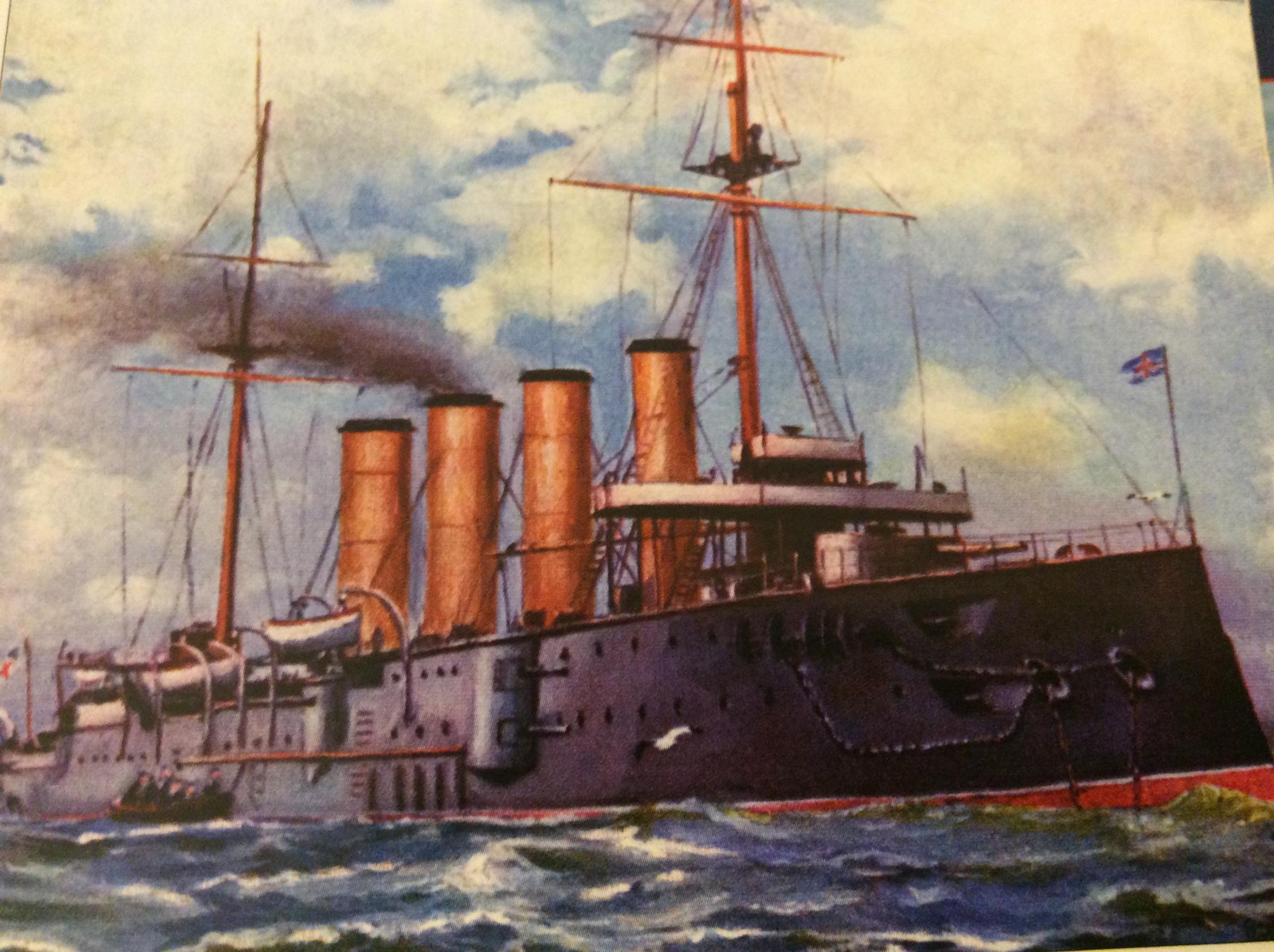
Petty Officer Stoker Herbert William Harrell, aged thirty six, husband of Anna Maria of London Street, Brancaster, served on the armoured cruiser Cressy in 1914. The Cressy was in company of two other such vessels, Aboukir and Hogue. They had been tasked with patrolling the Broad Fourteens in the North Sea to protect the eastern end of the English Channel. The armoured cruiser class of warship was obsolete at this time; these three ships were worn out and should not have been patrolling in such dangerous waters. They were travelling at 10 knots in line abreast without zigzagging when sighted by U-9, a German submarine commanded by Otto Weddigen: U-9 fired a torpedo which hit Aboukir. The captain thought the ship had hit a mine and requested the other two ships to close and transfer wounded men. As Hogue moved in she was hit by two torpedoes and capsized in ten minutes. Cressy, having tried unsuccessfully to ram the submarine, which had surfaced unexpectedly, then continued to rescue the hundreds of sailors in the water. She too was hit by two torpedoes and quickly sank. 62 officers and 1397 ratings were lost in total, although fishing trawlers nearby and other arriving warships managed to rescue 837 men. 560 of those lost came from the Cressy, among whom was Petty Officer Stoker Harrell. His death is remembered on the Brancaster war memorial situated at the front of St. Mary’s Church, Brancaster. Following this disaster, ultimately the responsibility of poor Admiralty decisions, instructions were issued that in future ships were not to stop and rescue survivors of torpedoed vessels.
For further details on either of these subjects, there is a wealth of information available online.
The pictures show a requisitioned steam trawler and HMS Cressy.